
Hospital stocks have emerged as a strong theme in 2026, outperforming benchmark indices due to robust earnings growth, improved occupancy, higher average revenue per occupied bed, and aggressive expansion plans by major chains.

The Indian rupee depreciated 20 paise to close at a fresh all-time low of 94.88 against the US dollar, driven by surging Brent crude oil prices, hovering around USD 115 per barrel, and persistent foreign capital outflows.

The Indian rupee appreciated by 23 paise to settle at 92.91 against the US dollar, driven by a weakening American currency, retreating crude oil prices, and renewed foreign institutional investor (FII) inflows amid increasing hopes of easing geopolitical tensions.

The Indian rupee depreciated by 28 paise to settle at 93.44 against the US dollar, influenced by ongoing uncertainties surrounding West Asia peace negotiations, volatile crude oil prices, and the Reserve Bank of India's recent adjustments to non-deliverable forward market regulations.

Dr Lovi Raj Gupta, pro vice-chancellor, Lovely Professional University, explains how aspiring professionals can equip themselves for a competitive AI-driven job market.

Indian benchmark indices, Sensex and Nifty, closed marginally higher after a volatile trading session, driven by value buying in IT and select blue-chip counters, despite global crude price hikes and a weak rupee.

Indian equity benchmark indices, Sensex and Nifty, ended marginally lower in a volatile trading session, surrendering early gains due to profit-taking in blue-chip stocks and persistent macroeconomic concerns, despite positive global cues.
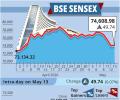
Indian benchmark equity indices, Sensex and Nifty, closed marginally higher, breaking a four-day losing streak, despite elevated crude oil prices and ongoing geopolitical uncertainties. The market saw a temporary pause in panic selling, though cautious sentiment persists.

Meta's new Muse Image AI generator, which can create AI images from public Instagram accounts without explicit consent, has sparked significant privacy concerns and criticism over its 'opt-in-by-default' approach, raising fears of deepfakes and online impersonation.

Indian benchmark indices Sensex and Nifty closed lower, snapping a two-day rally, as a spike in crude oil prices, triggered by reports of fresh US military operations in southern Iran, dampened investor sentiment and reignited fears of renewed energy supply disruptions.

Indian benchmark indices Sensex and Nifty experienced a significant slump in early trade, mirroring a sharp decline in global equities and a fresh spike in crude oil prices, exacerbated by simmering tensions in West Asia and a global unwinding of the AI-led rally. Track how sensex, Nifty fared on June 8.

Indian benchmark indices Sensex and Nifty extended their winning streak to a fourth consecutive day, driven by strong buying in blue-chip bank stocks and a decline in global crude oil prices. Fresh foreign fund inflows also contributed to the optimistic sentiment in the domestic equity market.

IT stocks had their worst first half fall in decades, with the Nifty IT index declining 31% in the January-June 2026 period, its biggest decline in the first six months of a calendar year since 2003.

Algo strategies must be registered with stock exchanges.

The Indian rupee depreciated by 34 paise to close at 93.78 against the US dollar, marking its third consecutive session of decline. This fall is attributed to escalating crude oil prices driven by uncertainty surrounding US-Iran peace talks and fresh attacks in the Strait of Hormuz, alongside significant foreign institutional investor outflows from domestic equity markets.

Indian benchmark stock indices, Sensex and Nifty, experienced a significant decline for the third consecutive day, with the Sensex tumbling 1,092 points and Nifty closing below 24,550. This downturn was primarily driven by the India Meteorological Department's forecast of a below-normal southwest monsoon and ongoing geopolitical uncertainties surrounding the US-Iran ceasefire arrangement.

The Indian stock market's movement this week will be significantly influenced by the outcome of US-Iran talks, global crude oil prices, and the trading activities of foreign institutional investors (FIIs), according to market analysts.

The case for long-term investment in gold, however, remains intact.
Indian benchmark indices, Sensex and Nifty, closed lower, primarily due to a sharp sell-off in IT stocks, a fresh surge in crude oil prices, and sustained outflows from foreign institutional investors. The Sensex dropped over 300 points, while the Nifty declined by 77.95 points.

The Indian rupee depreciated 16 paise to settle at a fresh lifetime low of 96.86 against the US dollar, marking its ninth consecutive session of decline, driven by elevated global crude prices and a strong dollar.

Gold and silver prices experienced a significant drop in the national capital due to a global selloff driven by inflation concerns, central bank policies, and geopolitical tensions.

Smallcap funds give investors access to businesses that can grow much faster than the broader economy.
Indian equity benchmark indices, Sensex and Nifty, tumbled nearly 2 per cent for the fourth consecutive session, driven by elevated crude oil prices, escalating US-Iran tensions, unabated foreign fund outflows, and a depreciating rupee.
Indian equity benchmark indices, Sensex and Nifty, tumbled nearly 2 per cent for the fourth consecutive session, driven by elevated crude oil prices, escalating US-Iran tensions, unabated foreign fund outflows, and a depreciating rupee.

With hot weather due and memories fresh of the scorching 2025 Club World Cup, FIFA has for the first time mandated three-minute hydration breaks in each half for all 104 matches of the World Cup starting this week in the U.S., Mexico and Canada.

Indian benchmark equity indices, Sensex and Nifty, extended their rally for a fifth consecutive session, driven by optimism surrounding a potential US-Iran peace deal and a significant drop in crude oil prices. Despite hawkish remarks from the US Fed, investors remain hopeful that easing energy prices could temper inflationary pressures.

Indian benchmark equity indices, the BSE Sensex and NSE Nifty, experienced a significant drop in early trade due to elevated oil prices, weak global market trends, and renewed fears of military operations in the Middle East following US President Donald Trump's statements regarding Iran. Track Sensex, Nifty on May 20.
Indian equity benchmark indices Sensex and Nifty experienced a significant tumble in early trade, with the Sensex tanking nearly 700 points, driven by uncertainty surrounding US-Iran negotiations, a fresh spike in crude oil prices, and persistent foreign fund outflows.

Analysts predict that inflation data, the US Federal Reserve's interest rate decision, and crude oil price trends will be the primary factors influencing the movement of Indian stock markets. Geopolitical developments, particularly the US-Iran deal, and foreign investor activity will also play a crucial role.

Indian stock markets are poised for volatility this week, driven primarily by the outcomes of five state assembly elections, ongoing high crude oil prices amid West Asia tensions, and the release of Q4 corporate earnings, according to market analysts.

Godrej Properties closed FY26 with record bookings and presales, exceeding its annual guidance, but brokerages express concerns over weak cash-flow generation and the ability to sustain growth amidst a muted real estate market.
The Indian rupee depreciated by 52 paise to settle at 93.35 against the US dollar, driven by failed US-Iran peace talks, surging crude oil prices due to a potential US blockade of Iranian ports, and a global flight to the greenback. This geopolitical uncertainty is also leading to foreign capital withdrawal from domestic equities.

The FIFA World Cup trophy's gold content has more than doubled in value since 2022, now estimated at USD 713,000, driven by a broader rally in gold prices due to geopolitical tensions and economic uncertainty. This makes it the most valuable sporting trophy by melt value, significantly surpassing other major awards like the Champions League and American sports trophies.

Indian benchmark stock indices, Sensex and Nifty, closed nearly 1 per cent lower due to surging crude oil prices, weak global market trends, and significant foreign fund outflows, with geopolitical tensions and inflation concerns further dampening investor sentiment.
Indian benchmark indices, Sensex and Nifty, ended lower in choppy trade, with the Sensex declining 114 points, as investors reacted to unabated foreign fund outflows and rising geopolitical uncertainties.

Indian benchmark equity indices, Sensex and Nifty, saw gains in early trade, driven by strong performance in banking shares and positive sentiment from Asian markets, alongside optimism surrounding the ongoing US-China Summit.

Indian stock markets, including the Sensex and Nifty, rebounded significantly, driven by a decline in crude oil prices and positive global cues stemming from hopes of diplomatic progress in US-Iran negotiations.
Indian investors have seen their wealth erode by a staggering Rs 16.77 lakh crore over four trading sessions, as the markets faced deep losses driven by elevated crude oil prices, geopolitical tensions, persistent foreign fund outflows, and a record-low rupee.

Indian benchmark indices Sensex and Nifty experienced a significant slump in early trade, mirroring weak global trends, as escalating tensions in West Asia, particularly a drone attack on the UAE's Barakah nuclear facility, pushed crude oil prices higher. Track Sensex, Nifty50 movement and key market drivers for May 18, 2026.
Indian benchmark indices Sensex and Nifty experienced a significant slump in early trade, driven by a sharp surge in crude oil prices above USD 120 per barrel, weak global market trends, and continued foreign fund outflows.
